
Some notes on Docharty’s life, largely from an article by Robert M. Campbell – a copy of which he kindly forwarded to me – published in The Munro Society Journal, no.4, 17 Dec 2016. The article includes a more detailed discussion of Docharty’s methods than given here, and compares them with other lists, such as the Corbetts and Grahams.
William McKnight Docharty was born on 3 August 1895 in Ruglen, South Ayrshire. He had an older brother Joseph, born in 1891, and sister [May Rankine Docharty], 1898. His parents were the landscape painter Alexander Brownlie Docharty, and Catherine McKnight, a teacher. [Alexander’s uncle, James Docharty, was also an accomplished landscape artist. May Docharty, who died in 1972, became a gifted player and teacher of contract bridge. She owned and managed the Western Bridge Club in Glasgow which she formed after her father`s death.]
Little is know about William’s early life, but by 1901 the family had moved to Glasgow and he took employment with the P&O company. When war came along he joined the King’s Regiment (Liverpool), eventually becoming a Major. He was awarded the Military Cross in 1917 for leading two companies as a temporary captain during action on the Western Front. He sustained a serious leg injury in October 1918 at the second battle of Le Cateau [almost losing the limb, but over a period of a decade managed to recover full use of it, according to his own notes in the foreword of his 1954 book].
In 1929, returning from a P&O posting in Cairo, he was very struck by the mountain scenery on a visit to the Jungfrau/Eiger region in Switzerland, and within a short time became a dedicated mountaineer, counting John Montgomery Thomson, son of the founder of the SMC, as a close friend and mentor. It was Thomson who gave Docharty the idea of surveying the 2500-foot hills of Scotland, and the pursuit of these passions occupied the rest of his life.
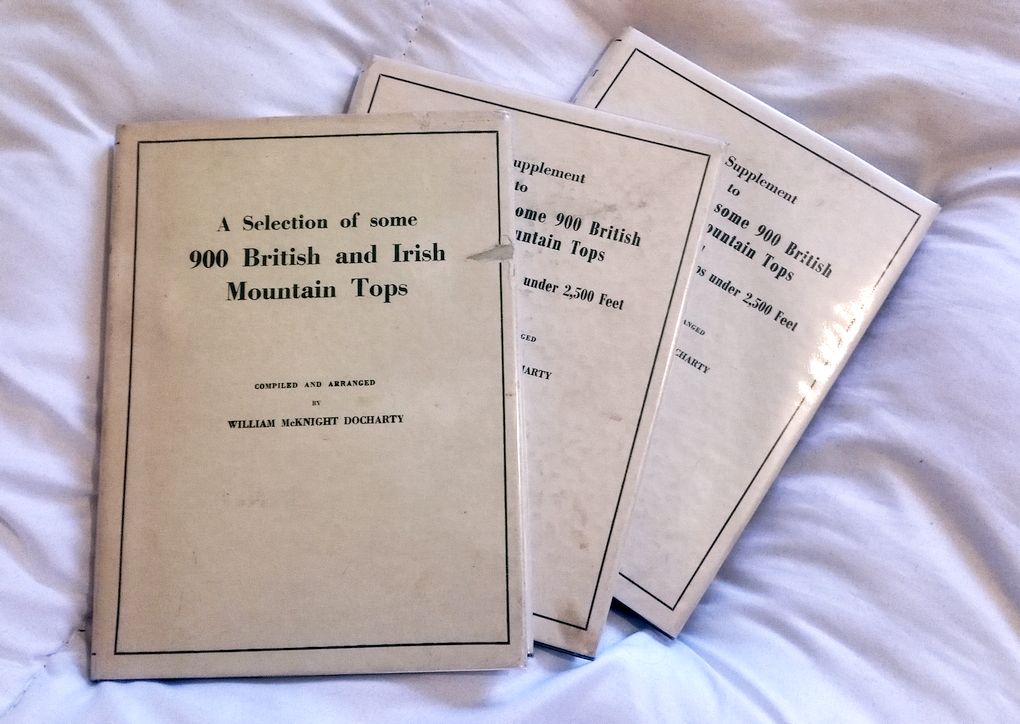
Docharty’s method of choosing tops was based on studying contour rings on Ordnance Survey maps, sometimes modifying his choice of what to include based on personal judgements about the surrounding topography or actual visits.
In the 1954 volume, Docharty explains that he has only included tops from 2500-2999 feet in Scotland because Munro had already detailed higher elevations, but …
… in Ireland, Wales, and England where the area of higher ground is so much less than in Scotland, every “top” of 2,500 feet and over has been noted … the minimum requirement for consideration of an eminence for the “Tops” column is ONE 50-foot contour … In the case of Ireland the minimum is ONE 100-foot contour on the ½-inch Survey of Ireland Maps … In my opinion, however, some of these elevations lack the individuality for inclusion in the “Tops” column … Now and then while on excursion a “top” or eminence unrecorded on the maps has been discovered …Docharty, W. M. (1954) A Selection of some 900 British and Irish Mountain Tops, Darien Press Ltd, Edinburgh, pp19-20.
In presenting his findings Docharty uses tables of sometimes mind-boggling complexity, which may in part explain why his lists have never achieved popular ‘checklist’ status. In addition to this, different criteria are used for different parts of the British Isles. The lists are therefore a mixture of quantitative and qualitative data and the listings are discontinuous and split between the 1954 and 1962 publications. Many of the lesser tops never benefited from a personal visit, so it could also be considered an incomplete work.

However, all this is judging the work purely from the point of view of a use as a checklist, which does a great disservice to something quite remarkable. The three volumes are a record of the author’s fascination with montane landscapes and were never intended for popular consumption, instead being produced as gifts for friends, fellow enthusiasts and selected institutions. They are a semi-autobiographical account of his exploration of the British Isles with the additional function of acting as a memento – something to look back on in his later years. The books are beautifully produced objects, being printed on high-quality paper and include large, fold-out panoramic photographs taken by Docharty himself with his Leica camera.
Note (15 Aug 2025): I have created a Excel summery of Docharty’s lists. but it needs further checking and tidying. I plant to post it on this page by the end of September.
Like Munro, Docharty listed mountains not according to a rigid formula, but according to whether he felt summits had enough ‘individuality’ (a word he uses many times) to be counted as truly independent mountains or tops. His plan was to extend the principle of Munro’s list across the whole of Britain and Ireland and include summits down to 2000 feet or even lower if he felt a summit worthy enough of inclusion. There are 149 such sub-2000 foot summits, the lowest being Dun, Iona, at 331 feet (101 metres), although most of the sub-2000s are well over 1000 feet.
The quality of the Ordnance Survey maps that Docharty used was surprisingly inconsistent in places, such as having poorly represented landscape morphology and height data being far less precise than today. Cook’s Cairn, a summit in the north-east Grampians is an example – the 1″ maps shows a well defined south-west summit with a 2541′ spot height, but it does not exist. When Docharty visited the location he discovered it was completely fictitious, stating simply “there is no eminence” in his notes.
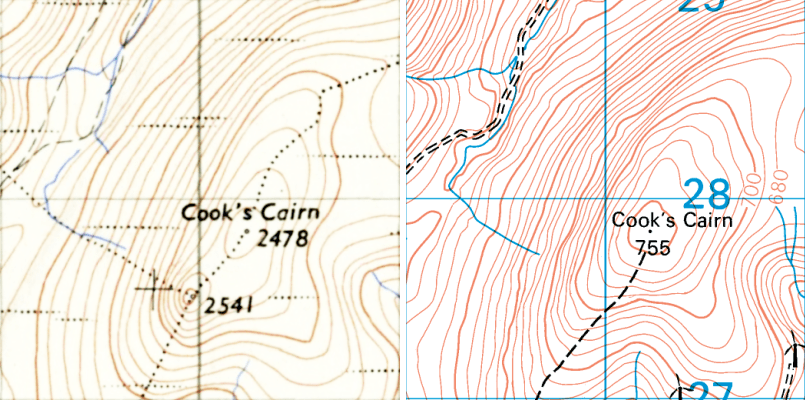
Cook’s Cairn (NJ302278) – 1″ and current 1:25000 maps.
Thankfully there are no other such extreme examples, but there are plenty of occasions where contours poorly represent the true shape of the landscape and summits can be indicated well away from their currently recognized locations.
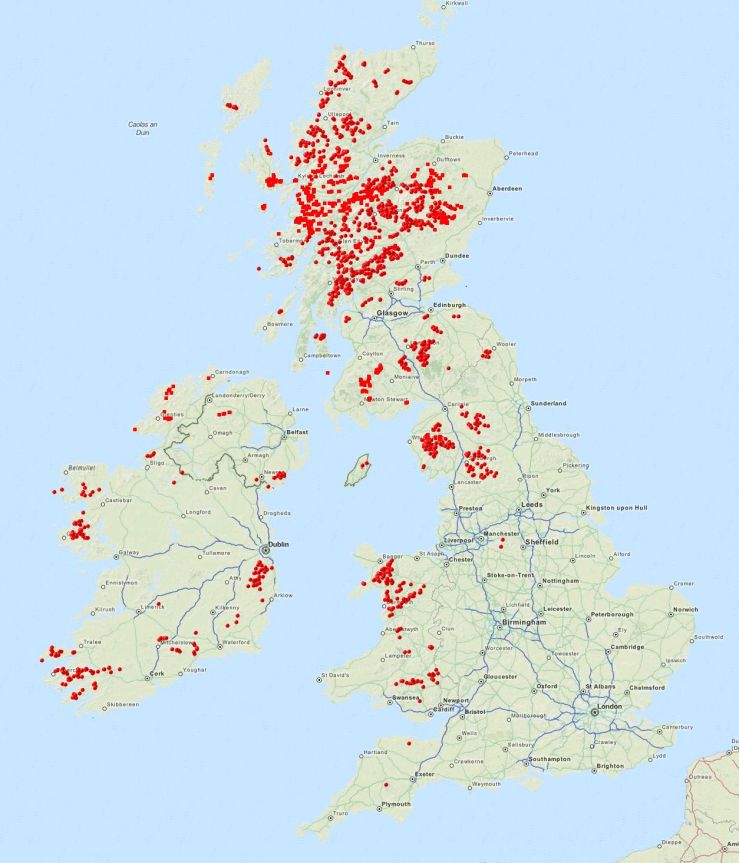
William McKnight Docharty died on 14 July 1968, aged 72.
Iain Thow has published an excellent and very thorough piece on William here: https://www.iainshillwanderings.co.uk/post/william-mcknight-docharty.
 JONRUS.COM
[…] HERE to see my interpretation of his lists as a single […]
LikeLike